
Friends of Grasslands
supporting native grassy ecosystems
PO Box 440
Jamison Centre
Macquarie ACT 2614
email: advocacy@fog.org.au
web: www.fog.org.au
Referrals Gateway
Department of Climate Change, Energy, the Environment and Water
Dear Referrals Gateway,
Re. Gungahlin Homestead Estate Site Redevelopment (EPBC 2026/10628)
Friends of Grasslands (FOG) is a community group dedicated to the conservation of grassy ecosystems in south-eastern Australia - natural temperate grasslands and grassy woodlands. FOG advocates, educates and advises on matters to do with the conservation of these ecosystems, and carries out surveys and on-ground work. FOG is based in Canberra and its members include professional scientists, landowners, land managers and interested members of the public.
While small in area, this proposal should be determined to be a controlled action because it is likely to have a significant impact on 0.03 ha of White Box - Yellow Box - Blakely’s Red Gum Grassy Woodland and Derived Native Grassland (BGGW; critically endangered); Golden Sun Moth, Synemon plana (Vulnerable), because 0.58 ha of occupied habitat will be cleared; and Striped Legless Lizard, Delma impar (Vulnerable), because 1.8 ha of occupied habitat will be cleared. For both these species, what is at risk are relatively large and viable (important) populations.
We consider there will also be a significant impact on Superb Parrot, Polytelis swainsonii. The referral documents considers the impact on the resident population, but downplays the significance of the site and underestimates the potential impact. About 10 years ago, the ACT Government undertook an unpublished tracking study to determine where Superb Parrots nesting within what is now part of the Goorooyarroo Nature Reserve were foraging. Figure 1 shows the trees along Bellenden St, and within the northern boundary of the proposed development, were both a foraging resource and a key linkage for the Superb Parrot feeding young in nests hollows to move east-west from Goorooyarroo to foraging sites in Kaleen and in the vicinity of the Australian Institute of Sport.
We recognise the master plan for the proposed development plans to retain most of the trees frequently utilised by Superb Parrots, however, the potential impact of the proposal on Superb Parrot movement and how that impact can be minimised needs proper assessment.
As the survey locations and habitat mapping of the Striped Legless Lizard have been redacted in the survey report, FOG is unable to check the veracity of the work done. We consider it important to note that relatively large numbers of striped legless lizards are known to exist nearby in areas of exotic grasslands. Thus, the exotic grassland on site should be considered viable habitat, and a connection (either exotic or native or a mix) should continue to be maintained to grassland along Gungahlin Drive and into Gungaderra Nature Reserve.
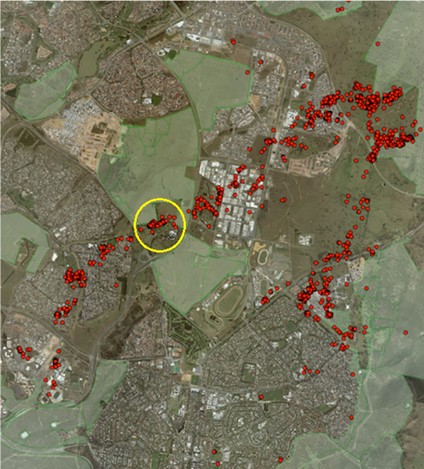
Figure 1: Where Superb Parrots that nest in Goorooyarroo Nature Reserve forage
Other matters that an assessment should consider include:
- Whether the scale of losses proposed (20% of mapped Striped Legless Lizard habitat and 10% of mapped habitat of Golden Sun Moth) is will lead to the existing populations becoming unviable.
- The condition of BGGW is not static; it can change under favourable climate and/or management conditions. Thus, there is the potential for more (and much) of the native vegetation within the area, if subject to appropriate management, to improve in condition to the extent that it meets the definition of being BGGW. Remnant woodland trees must be retained.
- Given the Striped Legless Lizard is vulnerable to cat predation, an assessment is needed concerning whether – if the development proceeds – the proposed community is either a no cat or strict cat containment facility.
- Foot traffic through the Hills, Ridges and Buffer zone must be appropriately planned to avoid dissecting or degrading significant woodland and Golden Sun Moth habitat patches.
- The Biodiversity Management Plan must be a public document so it is open to scrutiny and independent monitoring. It must detail what management actions will be undertaken, what the goals of management will be, e.g., maintaining a grass height of at least 15cm, habitat suitable for the Golden Sun Moth, how these goals will be monitored and what funding will be provided so that the Plan can be implemented and monitored.
Yours sincerely,
SIGNED
Professor Jamie Pittock
President, Friends of Grasslands
21 September 2026