
Friends of Grasslands
supporting native grassy ecosystems
PO Box 440
Jamison Centre
Macquarie ACT 2614
email: advocacy@fog.org.au
web: www.fog.org.au
Ms Karen Doran
PSM
Chief Executive Officer
National Capital Authority
via email:
dcp@nca.gov.au
Dear Ms Doran
Re. Draft North Curtin Residential Area - Detailed Conditions for Planning, Design and Development
Friends of Grasslands (FOG) is a community group dedicated to the conservation of grassy ecosystems in south-eastern Australia - natural temperate grasslands and grassy woodlands. FOG advocates, educates and advises on matters to do with the conservation of these ecosystems, and carries out surveys and on-ground work. FOG is based in Canberra and its members include professional scientists, landowners, land managers and interested members of the public.
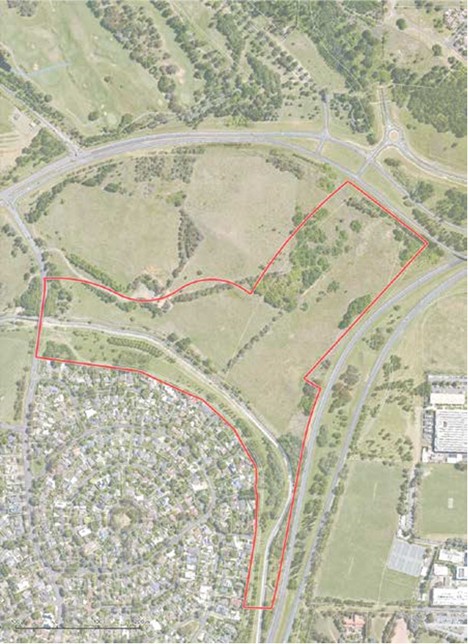
Thank you for the invitation to comment on the draft Detailed Conditions for Planning, Design and Development (DCPDD) for the ~29 hectare North Curtin Residential Area (the development site). We understand the development site is that shown in red outline in Map 1 below.
It is concerning comment has been invited on the draft DCPDD given it has been produced without a detailed understanding of the local environment and biodiversity. FOG find it surprising the draft has been published in this way, with the stated purpose of shaping the delivery of a new housing precinct, with street-scapes, open space and ecological restoration, without an investigation of the ecological values present. Some members have expressed offence, and/or found it disrespectful, to learn:
Environmental and ecological investigations will be required as part of the next steps in seeking approvals for development proposals. Development will be subject to approvals under the Environment Protection and Biodiversity Act 1999 as required.[1]
The approach does appear to add unnecessarily to consultation fatigue in the community.
In the absence of ecological information, our submission provides information. On learning what is of value and at risk in the development site and surrounds, we trust the proponent will consider their obligations to refer this proposal to the Federal Environment Minister for a decision under the Environment Protection and Biodiversity Conservation Act 1999 (EPBC Act) about whether an assessment and approval is needed before development plans go further. These referrals are typically accompanied by detailed ecological survey. Assuming the proponent will refer, FOG will look at the proposal again then.
The enclosure has been provided by FOG member Dr Michael Mulvaney, an expert with many years of experience as an ecologist learning about and interpreting the ACT environment. FOG is grateful to Michael for the time taken recording sightings and compiling the enclosed detailed information.
Map 1: The area covered by the Draft Detailed Conditions for Planning, Design and Development
From Michael's records and research, we know the whole area was once the threatened ecological community Natural Temperate Grassland of the South Eastern Highlands, listed under the EPBC Act at the threat level 'critically endangered' (Natural Temperate Grassland). Today, the development site and surrounds is known to include populations of grassland and grassy woodland flora and fauna; as noted above, however, precisely what species are present remains uncertain.
On the development, we note there is a commitment to retain a 50 per cent tree canopy cover over most of the area, an approach that may damage grassland species and their habitat. There is little detail concerning how environmental impacts will be avoided or mitigated, and no indication of how existing grassland values might be restored.
There appears to be little if any consideration of the regional ecological context. Michael's information, and the submission by Canberra Ornithologist Group (COG), seen by FOG, both demonstrate the development site and surrounds hold strong connectivity value, with multiple records of use by threatened woodland birds. The COG submission is supported.
Yours sincerely
SIGNED
Matt Whitting
Vice President, Friends of Grasslands
3 June 2026
Grassland Values Present in North Curtin
Natural Temperate Grassland potential patches and habitat elements
Known remnant patches of the threatened ecological community Natural Temperate Grassland of the South Eastern Highlands, listed under the EPBC Act at the threat level ‘critically endangered’, exist just outside the development site. This ecological community once occurred right across the development site. Within the development site are patches dominated by native grasses and, depending on climate and level of grazing, may at times contain sufficient native herbs to be considered as part of the critically endangered ecological community. Certainly, there is the possibility of restoring, enhancing and enlarging these patches as important remnants of the critically endangered community. A vegetation survey should map these patches and design should commit to their restoration, expansion and connection.
It is important to recognise that native grasses and key structural elements of the nature temperate grassland habitat occur across most of the proposal area. As such the bulk of the area is known or potential habitat for a suite of threatened, rare and uncommon grassland species.
The proposal area is habitat of a nationally important population of the nationally vulnerable Golden Sun Moth Synemon plana
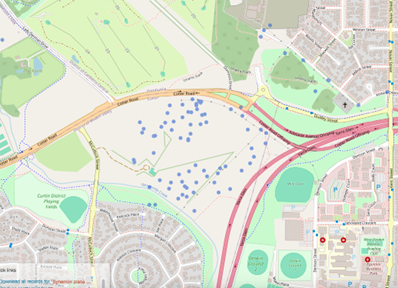
Figure 1 includes 71 records of Golden Sun Moth within the development site and surrounds. This is not surprising; FOG has advised of the likelihood of encountering Golden Sun Moth on the development site and surrounds before.[2] The threatened moth has been observed over much of the area, particularly the central and north-western area just outside the development site. The moth is also recorded from the median strip in Cotter Road and the grassland between the Cotter Road and Dudley Street in Yarralumla. The threatened moth has also been observed in grassland either side of Dunrossil Drive.
Figure 1. Golden Sun Moth Records – blue dots records from 2017-2024
Gaining an estimate of the moth population size at a particular site is problematic. Individual moths live only for a few days while populations emerge over an extended six to eight weeks. The rate and timing of emergence differs from day to day and from year to year and is highly influenced by climatic conditions. Counts at individual sites vary from opportunist counts over a few hours to seasonal monitoring. Richter el al (2009) categorised sites according to the number of moths recorded on the highest of 2-4 days of counting.
Table 1: Site Moth Population Comparison (After Richter et al 2009)
|
Size of Maximum Count |
Population size description |
|
>150 |
Very Large |
|
51 -150 |
Large |
|
21- 50 |
Medium |
|
<21 |
Small |
102 moths were counted within the development site and surrounds between 13-15/12/2020, indicative of a relatively large population present. In addition, male moths have been observed flying from the Dudley Street Grassland to the Curtin horse paddocks so that there is an exchange of genetic material between the two sites, and it can be argued that they are one population. The maximum moth count at the Dudley Grasslands is 373, indicating that the development site and surrounds is habitat of a very large population of the threatened moth. Mulvaney (2012) compared the population size and habitat area of the 73 Golden Sun Moth sites known at that time in the ACT. Of these, only three had a highest ever moth count, higher than that of the Dudley Street-North Curtin population, and only twelve (16%) had a higher population than when North Curtin is considered on its own. Similarly, 84 per cent of the ACT sites had a smaller habitat area than North Curtin (about 27ha). Mulvaney (2012) also found that the large majority of known Golden Sun Moth habitat across Australia was less than 5ha in area and had a maximum moth count of less than 20 individuals. Little has changed in the time since this paper, except several sites have been lost to development.
In a national context the proposal area is a large area of Golden Sun Moth habitat and together with the Dudley street grassland supports one of the largest known populations of the moth. The moth needs to comprehensively surveyed and design should seek to protect and enhance habitat.
The population found in the development site and surrounds may be an ‘important population’ as defined in the EPBC Act Significant Impact Guidelines 1.1[3], and the proposed development may reduce the area of occupancy of this important population.
Potential extensive habitat of nationally vulnerable Striped Legless-lizard Delma impar
As noted by the ACT Government (2017b), the nationally vulnerable Striped Legless-lizard was once most likely broadly distributed where-ever native grasslands were present. It has been recorded in degraded Natural Temperate Grasslands that are now dominated by exotic species such as Phalaris, Phalaris aquatica, Cocksfoot, Dactylis glomerata and Serrated Tussock, Nassella trichotoma. Degraded areas where the species has been recorded include a former quarry in Crace, that was converted to an asbestos dump and rehabilitated to grassland in the 1980s.
Except for those parts heavily shaded by trees, virtually all the development site and surrounds contains suitable habitat for Striped Legless-lizard. The area has never been subject to a survey for this lizard. D. impar has been found during surveys of grassland at Yarramundi Reach (2.5km to the north) and at Barton (4km to the east). Targeted surveys for this species need to be undertaken. If it is found to occupy the site, design should seek to protect and enhance its habitat.
Potential habitat of the threatened grasshopper Perunga ochracea
Perunga ochracea is a grasshopper with a restricted distribution, listed as vulnerable in the ACT. It is restricted to grasslands and open woodlands dominated by native grasses. There are patches of suitable habitat present in the development site and surrounds. It is a cryptic species and difficult to detect, except by opportunist sightings. As illustrated in Figure 2, it has been recorded widely in the general vicinity of North Curtin, including in the native dominated Mawson grassland adjacent to Yarralumla Creek, a habitat replicated in the development site.
Potential Perunga habitat with the proposal area should be identified and this habitat surveyed for the grasshopper.
Figure 2. Recorded locations (red dots) of Perunga grasshopper
Potential habitat of nationally endangered Key’s Matchstick Grasshopper Keyacris scura
Key’s Matchstick Grasshopper is usually found in native grasslands, but is able to feed on a wide range of plants, both exotic and native (Commonwealth of Australia 2022), many of which are found within the proposal area including: Silver hairgrass, Aira caryophyllea; Early Nancy, Wurmbea dioica; Curled Dock, Rumex crispus; Acetosella vulgaris; Sorrel, Rumex acetosella; Mouse-ear Chickweed, Cerastium glomeratum; Common Buttercup, Ranunculus lappaceus; Sweet Briar, Rosa rubiginosa; Acaena ovina; Subterranean Clover, Trifolium subterraneum; Haresfoot Clover, Trifolium arvense; Vervain, Salvia verbenaca; Great Mullein, Verbascum Thapsus; Field Madder, Sherardia arvensis; and Common Everlasting, Helichrysum apiculatum.
This grasshopper has been recorded at: Aranda snow gums, 3 km to the north; and Mcquoids Creek Kambah, 9km to the south-west, of the proposal area. During the 2008-2009 citizen science Golden Sun Moth monitoring, Michael Mulvaney also observed this grasshopper in a nearby patch of low quality native grassland by the bike path between the Royal Golf Club and Government House.
Survey for this species needs to occur across the development site and surrounds, and if located its habitat needs to be protected and enhanced.
Known occurrence of nationally endangered Hoary Sunray, Leucochrysum albicans subsp. tricolor
Three plants of this nationally endangered daisy were recorded within North Curtin on 27 Oct 2022.[4]
There was also a small patch of the daisy within the Cotter Road reserve adjacent to the development site. These plants were destroyed as part of infrastructure development, but offset plantings of the species occurred on the northern side of Cotter Road. There are possibly other plants within the development site and surrounds. The species needs to be surveyed for, and its habitat protected and enhanced.
Known occurrence of rare Pale Flax Lilly Dianella longifolia var. grandis
Dianella longifolia var grandis is known in the ACT under a synonym name Dianella sp. aff. longifolia (Benambra). It is considered as a rare plant species within the ACT. The ACT is the regional stronghold of this variety of Pale Flax Lily. A clump of Pale Flax Lily occurs within the development site; it and its habitat should be protected and enhanced.[5]
Uncommon grassland birds Brown Quail Synoicus ypsilophorus, Stubble Quail Coturnix pectoralis and Brown Songlark, Cincloromphus cruralis, are present and likely to be breeding within proposal area
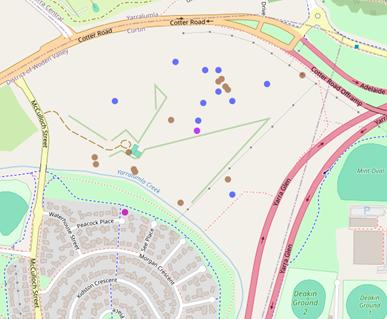
The Canberra Ornithologist Group and ACT Government consider both the Stubble and Brown Quails and the Brown Songlark to be uncommon breeding residents within the ACT (ACT Government 2017). As shown in Figure 3, both Quail species have been recorded within the development site and surrounds, and the Brown Songlark has over a number of years been recorded adjacent to the proposal area. The Brown Quail is known to have bred there, while it is likely that the Stubble Quail and Songlark also nest on the development site and surrounds.
The habitat of these regionally uncommon grassland birds should be surveyed and mapped and planning should seek to ensure sustainable populations of both species within the North Curtin area.
Figure 3 – recorded distribution of Brown Quail (brown dots), Stubble Quail (blue dots) and Brown Songlark (purple dots)
Grassy woodland Values Present in North Curtin
Threatened woodland bird and connectivity values of North Curtin
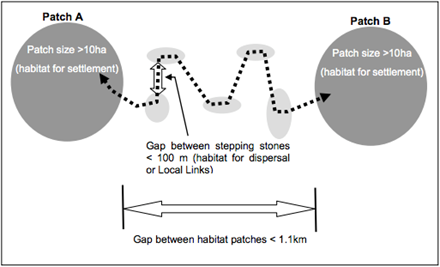
Doerr (2010) reviewed 80 wildlife studies (mainly birds and small mammals) to gain an understanding as to what structural connectivity (typically some form of native vegetation) is required to link habitat patches and enable wildlife to move across the Australian landscape. Structural connectivity includes the concept of wildlife “corridors” (linear, continuous connections between patches), but also encompasses a wide variety of landscape elements in the form of corridors, disconnected linear elements that do not directly connect patches, and “stepping stones”— series of isolated features such as individual trees, shrubs, rocky outcrops or small clusters of these features. Doerr (2010) concluded that most wildlife can move across the landscape provided that a habitat patch was at least 10ha in size, the distance between patches was not greater than 1100m and that there was a stepping stone every 100m (Figure 4).
Following further fieldwork and research, these parameters were slightly increased (largely for consideration of woodland birds) to 1300m between 10ha patches and gaps of less than 150m (Doerr 2017).
Barrett and Love (2012) utilised the initial structural connectivity parameters of Doerr (2010) to model least cost movement pathways across the ACT. That is they plotted all available movement routes and which of these provided the most efficient way to move across the Territory, by remaining in large habitat patches as much as possible and minimising the total and stepping stone gap differences between patches.
Figure 4: Graphical illustration of average gap crossing thresholds identified in the systematic review by Doerr et al. (2010). The darker patches represent habitat for settlement while the smaller light-grey patches show habitat for dispersal and may consist of either individual paddock trees or small patches (from Barrett and Love 2012).
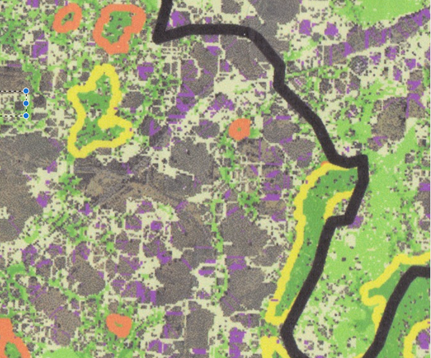
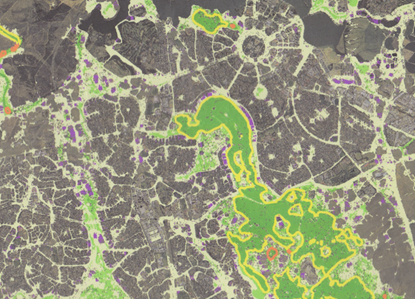
As illustrated in Figure 5, Yarralumla Creek and the North Curtin Area is the least cost pathway for movement between Red Hill (and then a very large woodland complex) in the east and the Molonglo River (and then onto the Murrumbidgee and Namadgi) to the west. At present the distance between liveable habitat (or habitat for settlement) is about 3km. The development site is in the middle of the two large habitat patches and could be enhanced to create a more functional link, though this would need to be balanced against grassland protection and restoration requirements.
As the best available option, it is not surprising that many migratory and more mobile resident species utilise the connectivity of the development site and surrounds. This includes species of woodland birds, bats, butterflies and other insects. Several of these species are threatened, rare or uncommon in a national or regional context.
Figure 5: Local Connectivity. Dark Green= high linkage value; Green = medium linkage value; light green/yellow = low linkage value; – no green shading = poor linkage value; (after Barrett and Love 2012).
Connectivity across proposal area is important to breeding and post-breeding movement of the nationally vulnerable Superb Parrot Polytelis swainsonii
Since about 2010, the Superb Parrot has been breeding in the lower Molonglo area. During the spring breeding season, originally male parrots and then as the young develop and the female is able to leave the nest, both sexes regularly travel from the nest trees, via the development site and surrounds, to forage on Red Hill and the Hughes – Garran area more widely. Post fledgling, families will travel to the foraging area and may continue to use the corridor and habitat elements within the development site and surrounds.
The potential impact of the proposal, its design and conditions on the Superb Parrot needs to be considered and addressed.
North Curtin is known foraging and possible nesting habitat of the nationally endangered Gang-gang Cockatoo Callocephalon fimbriatum
There are only 138 known nest trees of the Gang-gang across its entire range. Twenty-five are within Red Hill Nature Reserve, seven of these nest trees are in the Hughes Open Space connection to Red Hill Nature Reserve, one is on Curtin Ridge and two are within Curtin’s Open Space. Nesting pairs forage within the development site and surrounds, while nesting Gang-gangs are known to at least travel 4 km from a nest while feeding chicks. Wattles with green pods during November to January are a particularly important resource (Mulvaney and Booksmythe 2023). Both Red Leg Wattle, Acacia rubida, and Silver Wattle, A. dealbata, have green pods during this time and occur within the development site and surrounds, which is within 4km and foraging distance of a sizeable proportion of the Gang-gangs known nest trees (Davey et al 2025).
Gang-gangs have been seen inspecting hollows within the development area. In the Canberra area, about 13 per cent of all hollows inspected are utilised for nesting. Known nest trees close to the proposal include hollows in remnant: Blakley’s Red Gum, Eucalyptus blakleyi; Red Box, E. polyanthemos; Apple Box, E. bridgesiana; and Yellow Box, E. melliodora, as well as in planted Brittle Gum, E. mannifera, and Blue Gum, E. globulus (Davey et al 2025). A few of these trees occur within the development site and surrounds.
Use of North Curtin connectivity corridor by threatened woodland and migratory birds
The Scarlet Robin, Petroica boodang, and Flame Robin, Petroica phoenicea, are listed as a vulnerable species in the ACT and NSW. In warmer months, these robins are mainly found at higher altitudes. They disperse to lower altitudes in autumn and winter. During the cooler months they are often seen along the Molonglo Valley and on Red Hill (particularly the Scarlet Robin). Both move through the development site and surrounds, and pairs may spend a week or so there.
The White-winged Triller, Lalage sueurii, is also listed as a vulnerable species in the ACT and NSW. The Dusky Woodswallow, Aratumus cyanopterus, is listed as a vulnerable species in NSW. Both birds are summer migrants that breed in the Canberra area. Dusky Woodswallows largely breed in our woodlands. While they have a strong preference for woodlands, White-winged Trillers may pass through suburban areas in spring and may stay on in suitable habitat adjacent to the suburbs (Canberra Birds; accessed 5 May 2026). Both species utilise the development site and surrounds, and both have nested and bred in the area several times over the last 15 years. Dusky Woodswallow regularly frequent North Curtin especially during their autumn dispersal north from breeding grounds on the southern tablelands. Flocks of 30 birds are recorded most years. In dry years they breed in the paddocks particularly favouring nest sites in planted eucalypts. The area seems to be an important dry season refuge area for the species.
The Southern Whiteface Aphelocephala leucopsis, Diamond Firetail Stagonopleura guttata, Double‑barred Finch Stizoptera bichenovii and Varied Sitella Daphoenositta chrysoptera, are all woodland species that are listed as vulnerable in the ACT and NSW, and which are resident in the Canberra area. They all move across the landscape to varying degrees and all have been recorded within the development site and surrounds.
In relation to the woodland birds utilising the site, it is important to consider that seasonal usage of areas is as important for a species as year-round use. Habitat is where a species lives, no matter for how short a time. Even connectivity links should be considered essential habitat because once gone they are very difficult to replace. To think otherwise is to add to the phenomenon that ecologists refer to as ‘death by a million cuts’.
A house owner in Peacock place, opposite the development site, has recorded the birds in the vicinity of his house block over the last 33 years as part of the Garden Survey conducted by the Canberra Ornithologist Group. An indication of the scale of bird movement through the area is that, between 1993 and 2020 he recorded 170 different species of bird. This species richness is comparable to that of Tidbinbilla Nature Reserve and corresponds to roughly two thirds of the ACT total. There have been 14 vulnerable bird species recorded at this location. Reflecting the high bird diversity, 26 butterfly species (30% of all ACT’s Butterflies) have also been recorded within the development site and surrounds.
Another example of the importance and functionally of the wildlife corridor across the development site and surrounds is that two Superb Fairy-wren, Malurus cyaneus, siblings (sisters), tagged at Australian National Botanic Gardens by Andrew Cockburn (ANU), dispersed to North Curtin around west basin (approx. 7km). This was the longest dispersal recorded during this long-running research project.
References
ACT Government 2017. ACT native grassland conservation strategy and action plans (Environment, Planning and Sustainable Development, Canberra), https://www.act.gov.au/__data/assets/pdf_file/0008/2547440/act-native-grassland-conservation-strategy-and-action-plans-2017.pdf
ACT Government 2017b. Striped Legless Lizard Delma impar Action Plan, https://www.act.gov.au/__data/assets/pdf_file/0008/2545973/striped-legless-lizard-action-plan-2017.pdf
Barrett T. and Love J. (2012) Fine Scale Modelling of Fauna Habitat and Connectivity Values in the ACT Region. A report prepared for Conservation, Planning and Research, Environment and Sustainable Development Directorate. ACT Government.
Canberra Birds. https://canberrabirds.org.au/our-birds/canberra-garden-birds/cuckoo-shrikes/white-winged-triller/
Commonwealth of Australia 2022. Conservation Advice. Keyacris scura – Key’s Matchstick Grasshopper 05/10/2022
Davey, C., Mulvaney, M., Tyrrell, T. and Rayner, L. (2025). Breeding success of the Gang-gang Cockatoo in peri-urban Canberra for three breeding seasons: 2021 to 2023. Canberra Bird Notes 50(1): 31-44.
Doerr, VAJ, Doerr, ED and Davies, MJ (2010) ‘Does structural connectivity facilitate dispersal of native species in Australia’s fragmented terrestrial landscapes?’, Systematic Review No 44, Collaboration for Environmental Evidence.. http://www.environmentalevidence.org/SR44.html
Mulvaney M 2012. Golden Sun Moth (GSM) Draft Interim ACT Strategic Conservation Plan. Report for the Flora and Fauna Committee (Conservation Planning and Research, ACT Government, Canberra).
Mulvaney, M. and Booksmythe, I. (2023) Gang-gang Cockatoo diet as assessed by camera images and written recordsCorella 47: 8-15 https://absa.asn.au/wp-content/uploads/2023/04/4_V47_Pg8-15_GangGangCockatoo_V2.pdf
Richter A, Osborne W, Robertson G and Hnatiuk S 2009. Community Monitoring of Golden Sun Moths in the Australian Capital Territory Region, 2008-2009 (Institute for Applied Ecology, University of Canberra, Canberra).
Footnotes
[1] Q-A on the draft DCPDD consultation website
[2] FOG (6 June 2020) Comment: Draft Amendment 95 - North Curtin Diplomatic Estate and Urban Area, www.fog.org.au/Submissions/20200606a.htm
[3] Department of the Environment (2013) EPBC Act Significant Impact Guidelines 1.1, https://www.dcceew.gov.au/sites/default/files/documents/nes-guidelines_1.pdf, p. 10
[4] Naturemapr (27 Oct 2022) Leucochrysum albicans subsp. tricolor sighting, https://canberra.naturemapr.org/sightings/4450917
[5] Naturemapr (8 Jun 2020) Dianella sp. aff. longifolia (Benambra) sighting, https://canberra.naturemapr.org/sightings/4261660